Long vs Short: Buying and Selling Explained
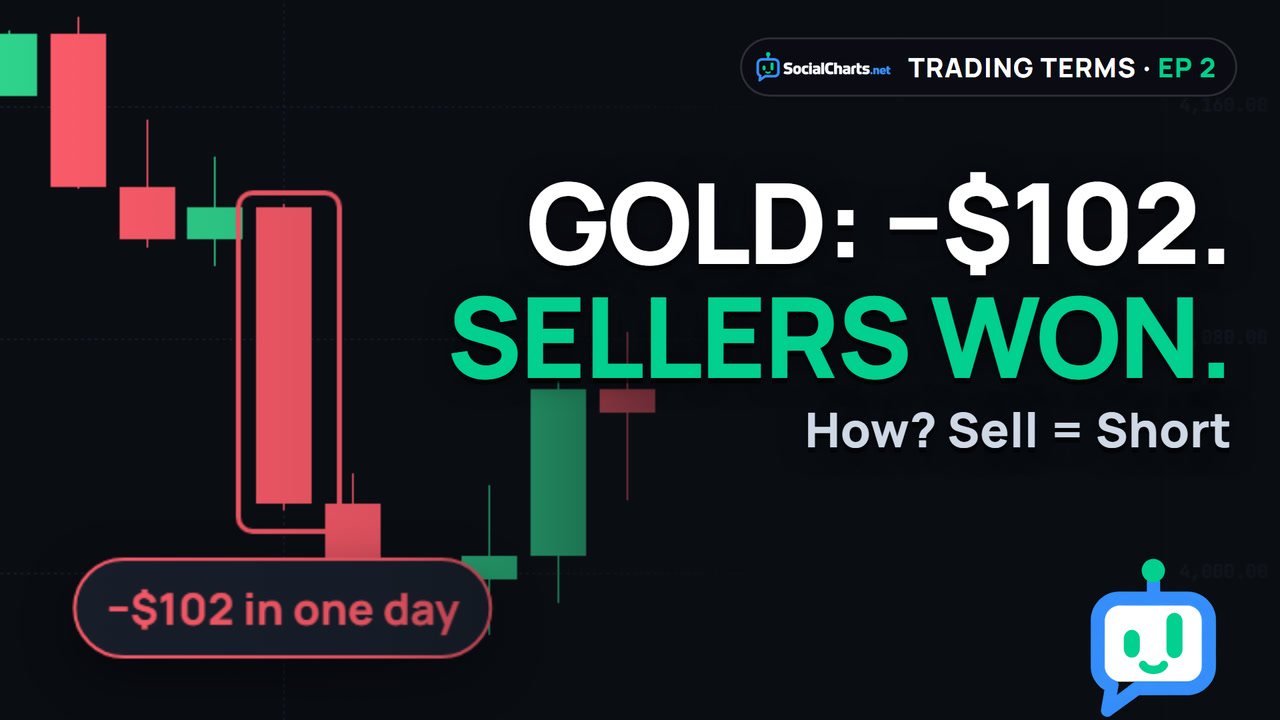
On October 22, 2026, gold fell about $100 in one day. Some traders lost money that day; others made money from the fall. Here is how, with real prices.
Pressing Buy opens a long position: you buy first, sell later, and can profit if price rises. Pressing Sell opens a short position: you sell first, buy back later, and can profit if price falls. In currency and gold trading you do not need to own the asset to sell first. Both sides pay the spread, and both can lose.
Buy = long
When you press Buy, you open a long position: you buy first and sell later. You can make money if the price rises.
Gold on October 27, 2026: say you bought at the open, 4005.51, and sold at the close, 4062.72. Price rose about $57: that is about 572 pips of profit before costs (on SocialCharts, one gold pip is $0.10).
Sell = short
When you press Sell, you open a short position: you sell first and buy back later. You can make money if the price falls.
You do not need to own gold first. In currency and gold trading, selling first is as normal as buying first.
Gold on October 22, 2026: say you sold at the open, 4125.36, and bought back at the close, 4023.71. Price fell about $102, so the short gained about 1,017 pips before costs.
Two sides
Every trade has two sides. For these examples, the same move gives one side a gain and the other an equal loss before costs:
| Day (open → close) | Move | Long | Short |
|---|---|---|---|
| Oct 27, 2026 | +$57.21 | +572 pips | −572 pips |
| Oct 22, 2026 | −$101.65 | −1,017 pips | +1,017 pips |
Pip figures are rounded. These examples ignore the spread and other costs; they only show the terms.
Long or short, price can always go the wrong way. Neither side is safe.
Bid and ask
A price quote has two numbers. The bid is the price you can sell at; the ask is the price you can buy at. Gold on October 29, 2026: bid 4025.23, ask 4025.42.
- A long opens at the ask and closes at the bid.
- A short opens at the bid and closes at the ask.
The gap between them is the spread: here $0.19, or 1.9 pips. You pay it on every trade, long or short.
Recap
- Buy = long: you can profit if price rises.
- Sell = short: you can profit if price falls.
- Both pay the spread, and both can lose.
Pips are explained in What Is a Pip?. The money value of one pip depends on your position size. That is the next lesson, What Is a Lot?
Frequently asked questions
What does going short mean?
Selling first and buying back later. You can profit if price falls and lose if it rises.
Do I need to own gold to sell it?
No. In currency and gold trading, opening a position with Sell is as normal as opening one with Buy.
Is a long position safer than a short?
No. Either side can lose when price moves the wrong way, and both pay the spread.
What is the spread?
The gap between the ask (where you buy) and the bid (where you sell). On gold on October 29, 2026 it was $0.19, or 1.9 pips.
See both sides on a live chart
Open gold and read the day’s move from open to close: which side would have gained before costs, long or short?
Keep learning
 Chart School · 2How to Find Support and Resistance: A Beginner’s Guide with Real Charts
 Gold Playbook · 1When Does Gold Move the Most? Gold’s Busiest Hours, Measured
 Trading Terms · 1What Is a Pip in Forex and Gold? Real Examples
Educational content only, not investment advice. Trading CFDs and forex involves a high risk of losing money.